Cherokee County Dog Registration Information
Service Dogs and Emotional Support Animals in Cherokee, Alabama
If you’re asking, “where do I register my dog in Cherokee County, Alabama for my service dog or emotional support dog,” the key point is that dog licensing (when required) is handled locally, while service dog and emotional support animal (ESA) status is handled under different legal rules. In practice, many residents start with the county’s animal shelter/animal services office for animal-related requirements and questions, and then confirm whether any additional city-specific rules apply where they live (such as within Centre, Cedar Bluff, or other municipalities).
- Dog licensing (sometimes called a dog “license” or “registration”) is a local requirement and commonly ties to proof of rabies vaccination.
- Service dogs are not “registered” through one universal federal registry. A service dog’s legal status comes from training to perform tasks for a person with a disability and is governed primarily by the ADA (for public access).
- Emotional support animals (ESAs) are also not registered through one universal government registry; ESAs are typically supported by documentation from a healthcare professional for certain housing-related accommodations.
Where to Register or License Your Dog in Cherokee County, Alabama
Cherokee County Animal Shelter
Cherokee County Probate Office (County Probate Offices Directory listing)
Cherokee County Commission Office (Department contact listing)
Overview of Dog Licensing in Cherokee County, Alabama
What “dog registration” usually means locally
When people say “register my dog” in Cherokee County, Alabama, they usually mean one of these local actions:
- Obtaining a dog license (sometimes a county or city-issued license/tag), if required by local ordinance
- Showing proof of rabies vaccination and keeping vaccination records current
- Updating ownership information for a pet if local records are maintained by animal services
County vs. city rules (why your address matters)
Cherokee County includes unincorporated areas as well as municipalities. In Alabama, many animal rules are enforced at the local level, and requirements can vary depending on whether you live:
- Inside the city limits of a municipality (where the city may set additional licensing or leash requirements), or
- In the county (unincorporated areas, where county enforcement and county facilities may apply)
If you’re trying to confirm the exact “dog licensing requirements Cherokee County, Alabama” applies to your home address, start with the Cherokee County Animal Shelter (animal services) and ask whether your municipality has separate rules.
What You Need Before Registering a Dog
Common documents and details
Local licensing processes typically rely on a few straightforward items. The exact list can vary, but residents commonly prepare:
- Rabies vaccination proof (certificate from a veterinarian showing current vaccination)
- Owner identification (driver’s license or other ID)
- Proof of residency (especially if licensing differs by city limits vs. county)
- Dog details: name, breed/type, color/markings, sex, approximate age
- Spay/neuter documentation (if local fees vary by sterilization status)
Why rabies vaccination is often central
Even when a “dog license” is not emphasized publicly, many local animal control and shelter procedures rely on current rabies vaccination records. Keeping your dog current on rabies vaccination helps with public health compliance and can be important if your dog is lost, impounded, or involved in a bite report.
Steps to Register or License a Dog in Cherokee County, Alabama
Step-by-step checklist
- Confirm the correct local office based on where you live (city limits vs. unincorporated county). Use the office list above to start with Cherokee County Animal Shelter and/or the County Commission office for routing.
- Verify licensing rules for your address: ask whether a county dog license/tag is required, whether the city issues its own license, and what proof is required.
- Gather your documents (especially proof of rabies vaccination and identification).
- Ask about fees and renewal timing (annual vs. multi-year, replacement tags, late fees, etc.).
- Complete the registration/license process using the instructions provided by the official office (in-person, by phone, or other approved method).
- Keep copies of your records (rabies certificate, receipt, tag number, and any local license documentation).
If your dog is a service dog or emotional support dog
A service dog or ESA may still need to meet local animal health and control rules (such as rabies vaccination and leash requirements), even though service/ESA status is not established by a county “registration.” If a local office offers a tag or notation for administrative convenience, ask what it means and what it does not mean (for example, whether it changes fees or is simply an informational record).
Service Dog Laws in Cherokee County, Alabama
No single “federal service dog registry”
Service dogs are not made “official” through one universal federal government registry. In most everyday scenarios, a dog is a service dog because it is trained to perform tasks for a person with a disability. Public access rights (such as entering places open to the public) are governed primarily by the Americans with Disabilities Act (ADA).
Service dog status vs. a dog license in Cherokee County, Alabama
A county or city dog license is about local animal regulation (public health, identification, and responsible ownership). Service dog status is about disability law and trained tasks. These can overlap in day-to-day life (your dog can be both “locally licensed” and “a service dog”), but they are not the same thing.
Practical local compliance for service dogs
- Keep rabies vaccination current and retain paperwork.
- Follow leash/control rules unless a leash interferes with the dog’s trained tasks (and you can maintain control by other effective means).
- Remember that local “registration” is not what grants public access rights; task-training and ADA coverage are what matter.
Emotional Support Animal Rules in Cherokee County, Alabama
ESA status is not the same as a service dog
An emotional support animal (ESA) is generally a pet that provides comfort that helps with a person’s symptoms or condition, but the animal is not trained to perform specific tasks in the way a service dog is. ESAs do not have the same broad public access rights as service dogs under the ADA.
Housing is the most common setting for ESA documentation
ESA documentation most often comes up for housing accommodations. A landlord or housing provider may have a process for requesting an accommodation and may request reliable documentation consistent with applicable housing rules. If you live in Cherokee County, Alabama and need an ESA for housing purposes, you’ll typically focus on:
- Following your housing provider’s accommodation request process
- Providing appropriate supporting documentation (as required in that context)
- Still complying with local animal rules like vaccinations and control
ESA status vs. dog licensing requirements Cherokee County, Alabama
Even if your dog is an ESA, local requirements may still apply (for example, proof of rabies vaccination and any applicable “animal control dog license Cherokee County, Alabama” process used where you live). ESA status does not replace local public health requirements.
Dog License vs. Service Dog vs. Emotional Support Animal (Comparison)
| Category | Dog License (Local) | Service Dog | Emotional Support Animal (ESA) |
|---|---|---|---|
| What it is | Local licensing/registration system (county and/or city) for pet identification and compliance | Dog trained to perform tasks for a person with a disability | Animal that provides comfort/support (not task-trained like a service dog) |
| Who issues it | Local government office (county/city animal services, shelter, or other designated office) | No universal issuing office; legal status is based on disability law and task training | No universal issuing office; status is typically supported by healthcare documentation in housing contexts |
| Common local requirement | Often requires proof of rabies vaccination; may involve fees and periodic renewal | Must still follow local health/safety rules (vaccinations, control) like any dog | Must still follow local health/safety rules (vaccinations, control) like any dog |
| Public access | No special public access rights | Broad public access rights under ADA in most places open to the public | Generally no ADA public access rights (not the same as a service dog) |
| Best use case | Compliance with local ordinances; helps identify owners if a dog is found | Assistance for disability-related tasks in daily life | Support/comfort; commonly relevant in housing accommodation requests |
Tip: If your goal is to comply with local rules and also understand your rights, treat these as three separate tracks: (1) local dog license compliance, (2) service dog legal status (ADA), and (3) ESA accommodation rules (often housing-related).
Frequently Asked Questions
Where to register a dog in Cherokee County, Alabama if I live outside city limits?
Start with the Cherokee County Animal Shelter (listed above). Ask what the county requires for dog licensing or registration in unincorporated Cherokee County and what proof (such as rabies vaccination) is needed. If your mailing address is in a municipality, confirm whether city rules apply even if you’re near the edge of city limits.
Do service dogs have to be licensed locally in Cherokee County, Alabama?
Service dogs typically must still comply with local public health and animal control rules (such as rabies vaccination and control requirements). Whether a separate local dog license is required can depend on local ordinances (county and/or city). If you want the most accurate answer for your address, contact the offices listed in the “Where to Register or License Your Dog in Cherokee County, Alabama” section.
Is there a single government registry for emotional support dogs?
No. ESAs are not registered through one universal federal government registry. ESA status is usually relevant for housing accommodations and supported by appropriate documentation in that context. Separately, local licensing and rabies vaccination rules may still apply as part of normal pet ownership requirements.
What if my city inside Cherokee County has different rules?
That can happen. Some municipalities set additional animal rules (like leash rules, nuisance ordinances, or local licensing procedures). If you live within a city’s limits, confirm whether you need a city license, a county license, or both. If you’re unsure, the Cherokee County Commission Office can help direct you to the correct department, and the Cherokee County Animal Shelter can often advise on the standard county process.
What should I bring when I call or visit about a dog license in Cherokee County, Alabama?
Have your rabies vaccination certificate available, plus your identification and your address. If your dog is spayed/neutered, have documentation ready in case fees differ. If you’re asking about a service dog or ESA, be prepared to explain whether you’re asking about local licensing compliance (public health) or about legal status/accommodations (ADA or housing), since those are handled differently.
Local laws, fees, office locations, and contact details can change. Residents should verify the most current information with their local animal services or licensing office in Cherokee County, Alabama.
What You May Need
Local SEO keywords (context)
This page focuses on: where do i register my dog in Cherokee County, Alabama for my service dog or emotional support dog, dog license in Cherokee County, Alabama, animal control dog license Cherokee County, Alabama, where to register a dog in Cherokee County, Alabama, and dog licensing requirements Cherokee County, Alabama.
Register A Dog In Other Alabama Counties
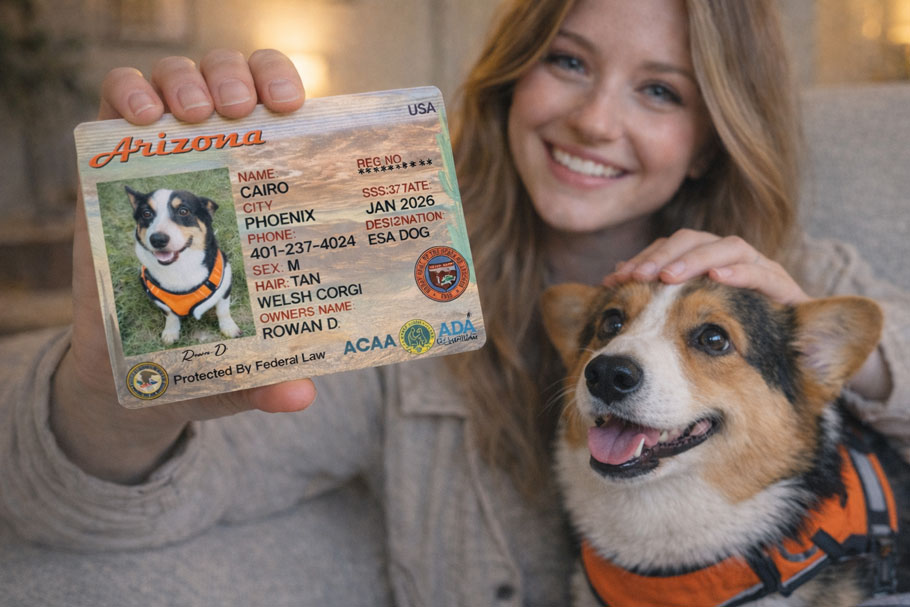
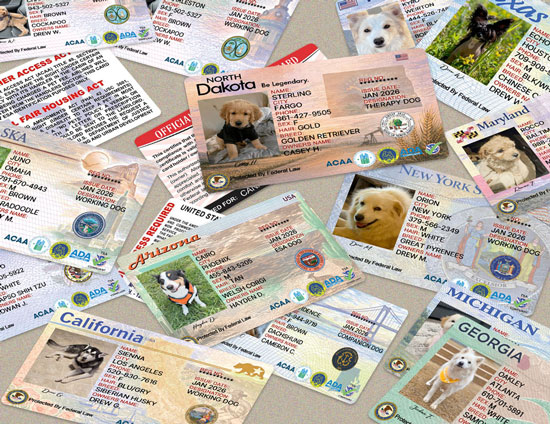
Select your county below to get started with your dog’s ID card. Requirements and license designs may vary by county, so choose your location to see the correct options and complete your pup’s registration.
- Autauga County Dog Registration
- Baldwin County Dog Registration
- Barbour County Dog Registration
- Bibb County Dog Registration
- Blount County Dog Registration
- Bullock County Dog Registration
- Butler County Dog Registration
- Calhoun County Dog Registration
- Chambers County Dog Registration
- Chilton County Dog Registration
- Choctaw County Dog Registration
- Clarke County Dog Registration
- Clay County Dog Registration
- Cleburne County Dog Registration
- Coffee County Dog Registration
- Colbert County Dog Registration
- Conecuh County Dog Registration
- Coosa County Dog Registration
- Covington County Dog Registration
- Crenshaw County Dog Registration
- Cullman County Dog Registration
- Dale County Dog Registration
- Dallas County Dog Registration
- DeKalb County Dog Registration
- Elmore County Dog Registration
- Escambia County Dog Registration
- Etowah County Dog Registration
- Fayette County Dog Registration
- Franklin County Dog Registration
- Geneva County Dog Registration
- Greene County Dog Registration
- Hale County Dog Registration
- Henry County Dog Registration
- Houston County Dog Registration
- Jackson County Dog Registration
- Jefferson County Dog Registration
- Lamar County Dog Registration
- Lauderdale County Dog Registration
- Lawrence County Dog Registration
- Lee County Dog Registration
- Limestone County Dog Registration
- Lowndes County Dog Registration
- Macon County Dog Registration
- Madison County Dog Registration
- Marengo County Dog Registration
- Marion County Dog Registration
- Marshall County Dog Registration
- Mobile County Dog Registration
- Monroe County Dog Registration
- Montgomery County Dog Registration
- Morgan County Dog Registration
- Perry County Dog Registration
- Pickens County Dog Registration
- Pike County Dog Registration
- Randolph County Dog Registration
- Russell County Dog Registration
- Shelby County Dog Registration
- St. Clair County Dog Registration
- Sumter County Dog Registration
- Talladega County Dog Registration
- Tallapoosa County Dog Registration
- Tuscaloosa County Dog Registration
- Walker County Dog Registration
- Washington County Dog Registration
- Wilcox County Dog Registration
- Winston County Dog Registration